By Per Tengstrand (Read time 6 minutes)
A Piano Concerto composed in 1810
Beethoven’s Emperor Concerto, his fifth and final Piano Concerto (he did start working on a sixth before he died) is one of the most popular concertos with audiences and pianists alike. While the first and third movements are powerful and magnificent examples of the Beethovenian energy that is so special, the slow movement is for many the most beautiful, tender music ever written.
I have performed it many times: with the Detroit Symphony, Cincinnati Symphony and National Symphony in D.C. among others.
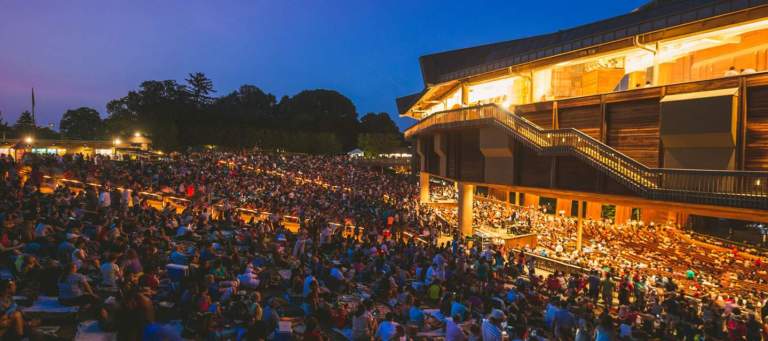
The concert with National Symphony was very special, it was at Wolf Trap (in the picture) with ten thousand people in the audience!
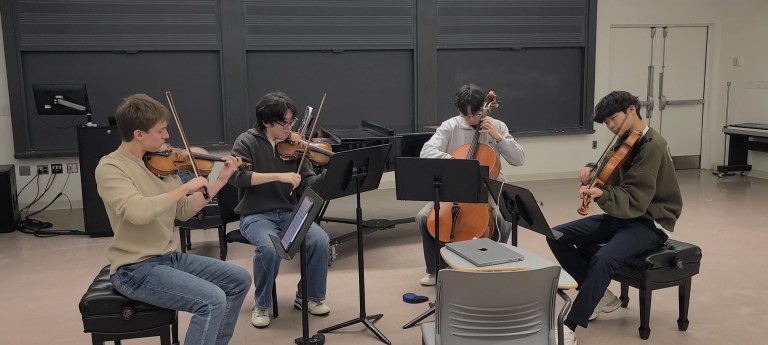
On January 20, we won’t be ten thousand, but a full Channing Hall is expected when me, Ian, Daniel, Jisang and Elliott will play the Emperor in my arrangement for piano and string quartet. At the same concert, we are pairing the old and well known with something new: when he is not busy studying Physics at Princeton or practicing violin, Ian Barnett is composing.
At the tender age of 15, Ian wrote a piece for orchestra that was named a winner in the National Young Composer’s Challenge Competition, and was performed by Orlando Philharmonic.
A String Quartet composed in 2024
You will have the chance to hear the first movement from his String Quartet No. 1. It is a beautiful piece. The first time I heard it I thought it had a French touch. It turns out I was not completely wrong:
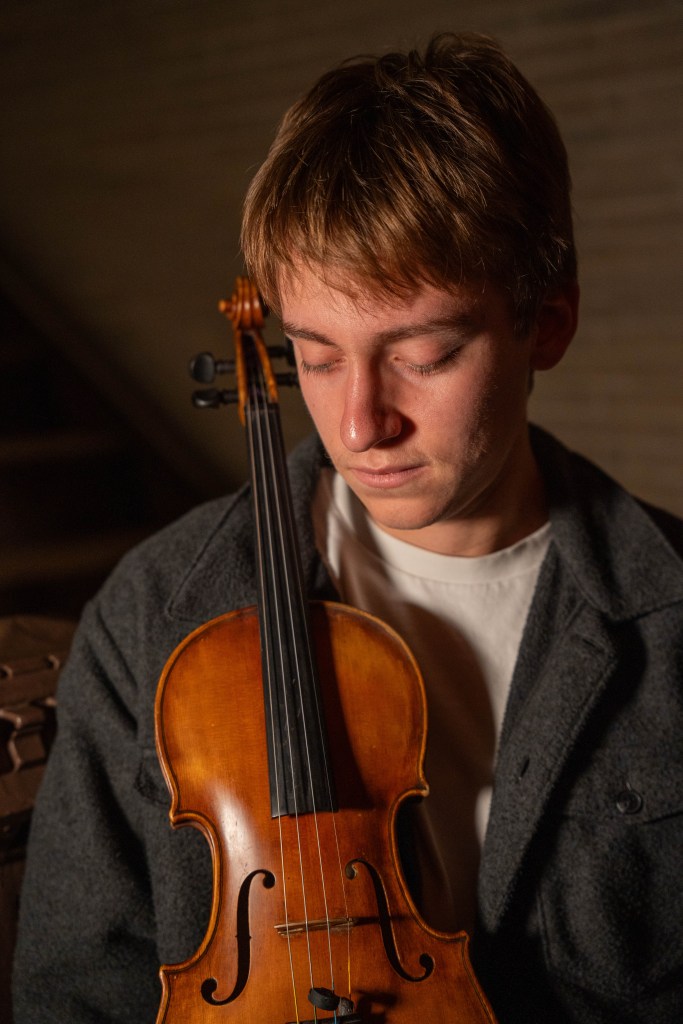
I wrote most of the piece in the summer of 2024, while at home. This piece is most directly influenced by Ravel’s string quartet (I was listening to it a lot at the time), and there are a few distinct moments where one can really hear this influence, especially in the harmonies.
As often with creative work, some solutions pops up in your mind in moments least expected. Why not during a math lecture? (Especially funny to me, being the son of a mathematician!)
i
“one day in a Math lecture it just came together in my head”.
In fact, I began thinking about writing a quartet already in January of 2024. I had played in a quartet with Daniel and Elliott a lot during my freshman year, and I wanted to write a piece for us to play together. I had a few sketches here and there, but nothing really solidified. The main theme of the piece remained unfinished, until this one day in a Math lecture, funnily enough, where it just came together in my head. This main theme that appears in the very beginning of the piece gets used time and time again during the work, played by different instruments, in different contexts.
Ian started writing music when he was around 6 years old.
It was quite casual, nothing very serious. I took a few lessons when I was younger to start getting a sense of form, balance, and other technical themes. I found, however, that listening/studying other composers was the best way in which I developed as a composer. So far, I’ve written a few short pieces for orchestra, a few pieces for string quartet and one or two piano violin pieces.
What’s in a name?
Most composers today put a name on their work. Funny enough the Beethoven Concerto on the program has a name, albeit not by Beethoven, but Ian is content with naming his piece in a traditional way, as String Quartet No.1
I’ve always struggled with naming my pieces. I’ve heard very compelling pieces of music both with and without names. I, however, prefer to not name my pieces if possible.
I feel like a piece of music speaks for itself, and unless the music is programmatic like a requiem or music based on written work (in which case a name is very important), then a name, to me, doesn’t add much except maybe some atmosphere.
I believe that the listener’s ability to craft their own interpretation of the work is of the utmost importance. For example, if a listener comes to me and describes a reaction that is far away from my intentions, that’s completely good and fine with me.
Getting stuck in creativity
Creative work is both fun and frustrating, because creativity can’t be scheduled. At the same time, all creators have to keep working on their music, script, film, book or whatever it might be, even when they feel stuck.
The issue about spontaneity in composing is very real to me, and I feel like every composer has to experience it at some point or another. Sometimes I get a burst of inspiration and get very excited to sit down and write it down, but other times, the piece kind of feels stuck.
In these moments where one might not be able to compose more than a bar or two a day, what I find comforting is that once I look back at the piece as a whole, especially a while after it was finished, I often can’t remember which parts I was stuck on!
Of course, for us it is very special to be able to hear the composer himself be part of the quartet that performs his piece, and Ian has promised he will say a few words about his piece before they play it.
When history meets today it can be a beautiful thing, like at this quite unique concert. We welcome you all!

From boarding at EWR to Emperor in Stockholm
As a little encore I want to tell one of my most positive stories in my life, which includes the Emperor Concerto:
Years ago, as I was waiting to step on the plane from Newark to Stockholm, I saw the conductor Alan Gilbert in front of me in the line. He was the chief conductor of Stockholm Philharmonic at the time, before he had the same position at the New York Philharmonic.
I hesitated, but finally decided to go up to him, present myself and give him a CD with the Emperor Concerto that I had recorded with Tapiola Sinfonietta, a superb Finnish orchestra. He was very nice and we chatted a bit, he went to his business class seat, I went to my not business class seat. After landing in Stockholm I went to a cabin a few miles outside of the city to rest and practice.
Two days later, I get a phone call from Stockholm Philharmonic. The pianist who was supposed to play at the inauguration of the renovated Philharmonic Hall in Stockholm had fallen ill, and Maestro Gilbert insisted I should replace said pianist (I am ashamed to say that I have forgotten who) with the Emperor Concerto!
And so it came to happen that I played the Emperor at the inauguration. It was fun BUT it will be even more fun on January 20!
 Princeton Chamber Music Series